
Essay
The Science of Not Being Photogenic
The research on why a photo of you can feel wrong, and why it isn’t your fault.
“I’m not photogenic” is one of the most common things said in my studio. It’s also one of the most common topics that portrait photographers use in their content. I’ve been doing this for 18 years and I’ve watched hundreds of these videos, and while I genuinely agree with everything they’re saying, they’re only skimming the surface.
If you’re one of the many who say you aren’t photogenic: it isn’t true, and there’s a fair amount of research to explain why it feels true anyway.
Why You Don’t Recognize Your Own Face
Part of the problem starts before a camera ever comes out. In 1968, a psychologist named Robert Zajonc showed that seeing something over and over is often enough to make you like it, with no reasoning involved. Feeling, he later wrote, can come before thinking.
Zajonc’s curiosity ran wide, from whether family size affects intelligence to whether long-married couples start to look alike. In 1977, researchers Theodore Mita, Marshall Dermer and Jeffrey Knight took his exposure idea and tested it on faces. They photographed a group of students, printed each photo two ways, true and mirror-reversed, and asked each student which they preferred. Then they asked a close friend or partner the same question. Most of the students preferred their mirror image. Their friends and partners preferred the true one. Each of them liked the face they were used to seeing. You see yourself in a mirror, and everyone else sees you the way a camera does.
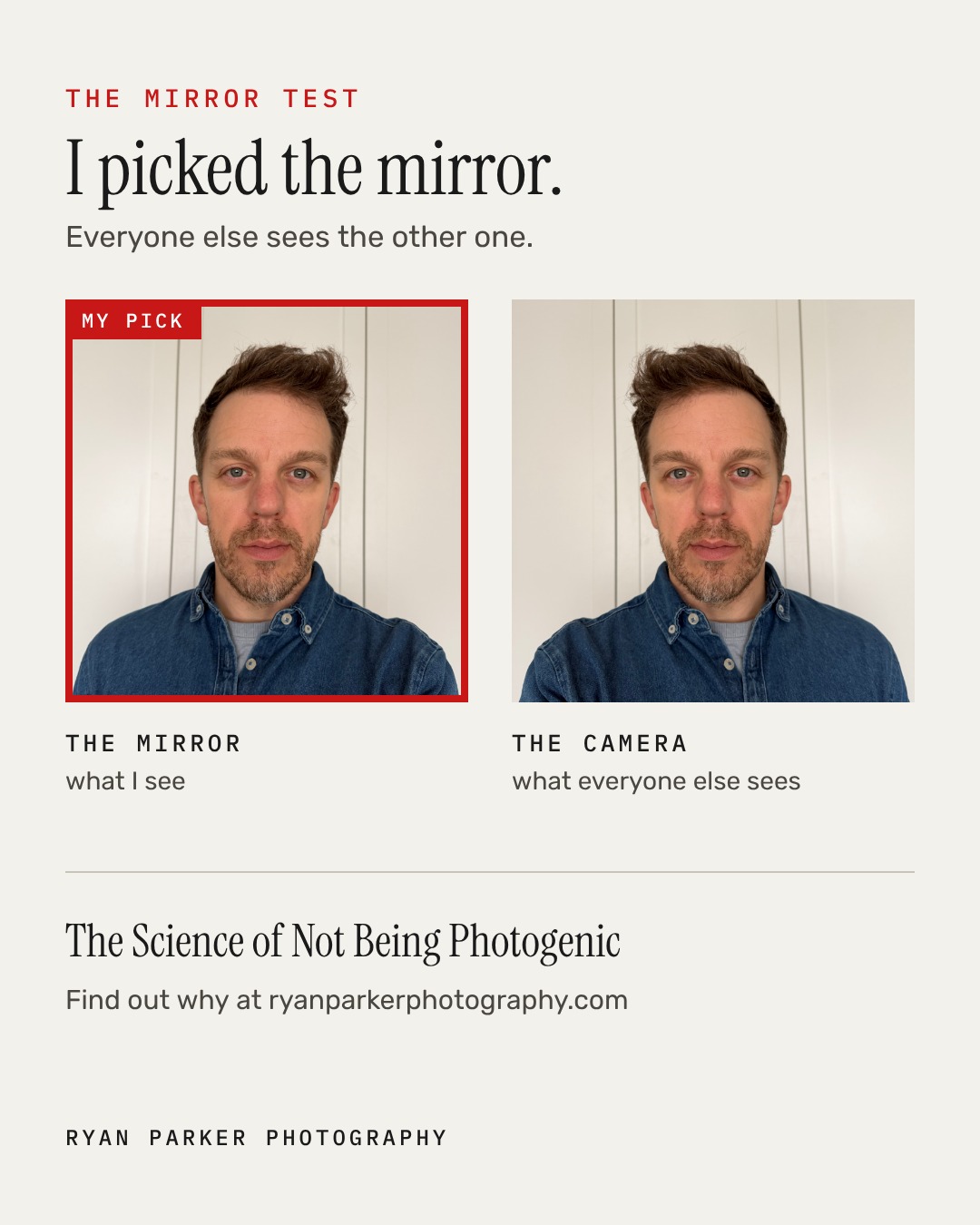
Try it
Take a selfie and you’ll see two versions of it. Pick the one that looks more like you.
Your photo stays on your phone. The site only counts whether you picked the mirror or the camera.
I saw this in my own studio. A client told me he never likes photos of himself, which I hear all the time. But his was more specific. He liked the selfies he took in Instagram. He didn’t like the ones he took with his phone’s camera. That’s when it clicked: Instagram was keeping his selfies the way they looked on the screen, flipped like a mirror, and his phone’s camera was flipping them back to the way everyone else sees him. He liked the face he was used to seeing, just like the students in 1977. So as we shot, we flipped every photo, and he got to see himself the way he knows himself. His finished photos went out flipped too. The true version was just too hard for him to look at.
None of this has anything to do with who is or isn’t “photogenic.” It’s a mismatch between the face you expect to see and the one the camera actually shows you, and it happens to nearly everyone.
The Version of You That Isn’t Real
There’s a second bias, and it’s a stranger one. In 2008, researchers Nicholas Epley and Erin Whitchurch photographed people, then morphed each face to look a little less attractive or a little more. A few weeks later, they showed each person a lineup of those versions and asked them to pick out their real, unaltered photo. Most picked a version that had been made more attractive, and they spotted the enhanced versions faster than the real one.
It didn’t happen with strangers. Shown a stranger’s lineup, people picked the real photo. But it did happen with close friends: asked to find a friend’s real photo, people drifted toward the flattering version again. And the stronger the bias, the higher the person’s implicit self-esteem, the kind of self-regard that runs automatically, below anything you’d say if someone asked. So it’s less about vanity than about how we see: the brain quietly improves the faces we’re closest to, our own included.
Selfies are where this shows up most now. A 2017 study in Frontiers in Psychology compared the same people in selfies and in photos someone else took. In their selfies, they were rated as less trustworthy, less socially attractive and more narcissistic. In 2016, a University of Toronto team led by Daniel Re had people take a selfie and then had someone else photograph them. Independent raters found the photos taken by someone else more attractive. And the people who took selfies regularly overestimated how good their own selfies looked, more than anyone else in the study.
You’re worst at judging the one face you feel most sure about: your own. That’s the best reason I know to have someone else behind the camera.
The Difference Between a Real Smile and a Performed One
The other half of this happens in real time, while the photo is being taken.
In the 1850s, a French neurologist named Guillaume Duchenne de Boulogne ran experiments applying mild electrical currents to individual facial muscles, and photographed what each muscle did on its own. Photography itself was less than twenty years old. When he published the results in 1862, it was one of the first scientific works illustrated with photographs. He compared two photographs of the same man: a smile made by his probe on the cheek muscle, and the man’s own real laugh. The real laugh used more than the muscles at the corners of the mouth. It also used the muscle that circles the eye, the orbicularis oculi. He wrote that this muscle “does not obey the will,” and that its absence in a smile “unmasks a false friend.” Charles Darwin used Duchenne’s photographs in his own book on emotional expression, and the work helped shape the Facial Action Coding System, which psychologists still use, along with the software that reads emotion from faces.
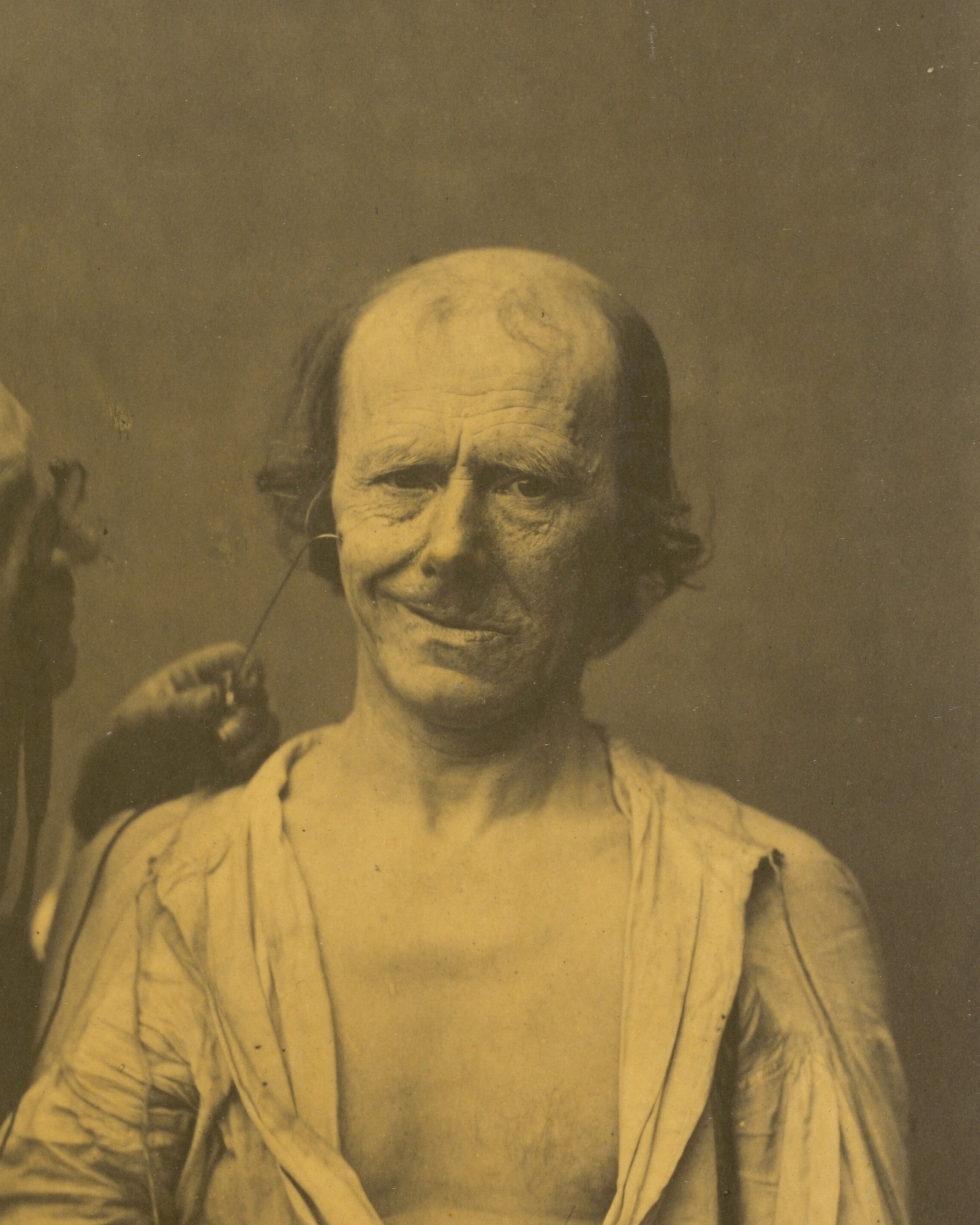
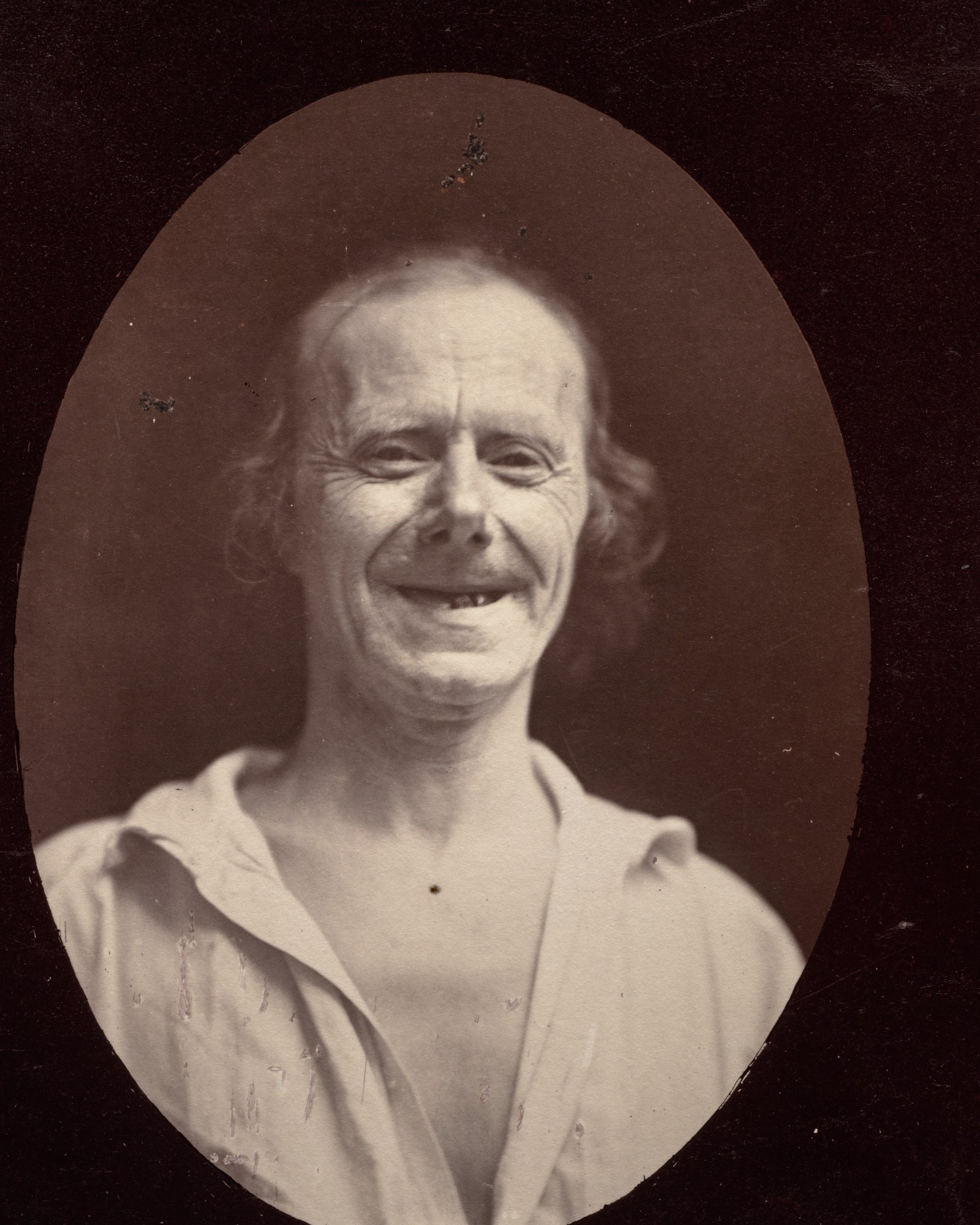
Try it
1 Orbicularis oculi2 Zygomaticus major
Grab Duchenne’s probe and touch it to a red muscle. Drag the head to turn it, and tap any muscle to see what it does.
A 2021 study tested it in a clever way. The researchers used people who’d had Botox in the crow’s-feet area, which paralyzes that eye muscle without touching the mouth. Comparing the same people’s smiles before and after treatment, the smiles with the eye muscle working were rated as more felt, more spontaneous and more intense. That eye muscle is doing real, measurable work.
Duchenne got one thing wrong, though. Later research found most people can bring that eye muscle in on purpose. In one study, seven out of ten people could copy a real smile from a photograph, eye crinkle and all. That’s good knowledge for an actor’s toolbox. But hold it as a pose and it heads right back toward “cheese,” another shape made on command. It works in motion, and the easiest way to get it is still to let it happen on its own, after a real smile.
That’s the mechanism. Here’s the trigger. Psychologists call it evaluation apprehension: the self-consciousness that shows up when you know you’re being watched or judged. It grew out of research on social facilitation, which found that people do simple, well-practised tasks better with an audience and complex or unfamiliar ones worse. In 1972, Nicholas Cottrell argued that what drives it is the fear of being judged, more than the audience itself. That’s why a camera can set it off with nobody else in the room. It stands in for everyone who’ll see the photo later.
Tension is what you see: shoulders rise, breathing shortens, the face stiffens into whatever expression feels safest. And a tense face falls back on a mouth-only smile. You’re capable of a real one. But a real smile needs you relaxed and present, and that’s exactly what evaluation apprehension takes away.
Here’s where I think the research leads somewhere most advice doesn’t. “Say cheese.” “Smile.” Two words, and they’re probably responsible for more bad photos than anything else. Both tell you to make a shape with your mouth, on command. What you get is a mouth-only smile, made under tension, without the eye muscle that makes a smile read as real. That’s Duchenne’s false friend. Every time someone says “cheese,” they’re teaching your face the fake version.
Getting the right expression isn’t something you should be managing at all. That’s not your job. It’s the photographer’s. Treating a photo like a still moment you need to build and hold, in the Goldilocks zone between “too neutral” and “too much,” is exactly what creates the tension, because you’re trying to freeze a target instead of just existing.
A real expression isn’t a fixed point. It’s a wave. It builds, it crests and it comes back down. Most people think they need to lift their face from neutral into that acceptable zone and hold it there, carefully, so it never tips into too big or too candid. The better version comes on the way back down from a real release: an actual laugh, an actual smile. What I see in every session is that a real peak doesn’t switch off evenly. The mouth relaxes almost right away, but the eyes ease off more slowly. On the way down, you pass through that same Goldilocks zone. The difference this time is that you aren’t managing it. You’re just living, and that’s where the depth in an expression comes from.
You can’t think your way into that window, and you’re not supposed to. A photographer watches for it and catches it. That’s the whole job, and nobody should expect you to master it on your own before you step in front of the camera.
Say This Instead
I think the words we use matter more than people realize, and the word itself makes the point. “Photogenic” comes from Greek roots meaning “produced by light.” It was first used in 1839, for photography itself: the earliest photographs were called photogenic drawings. Later, biologists used it for organisms that make their own light. The meaning we use today, someone who photographs well, doesn’t show up until 1928, almost ninety years later. The whole story people build around “I’m not a photogenic person” rests on a word that spent most of its life meaning something else entirely.
“I’m not photogenic” describes a fixed trait. You either have it or you don’t, with nothing to be done about it. “I find it hard to relax in front of the camera” describes a state. States can change. One is a life sentence. The other is an accurate, workable description of a moment, and it’s not something you should be expected to solve.
When you’re looking for a photographer, it’s worth looking for more than someone whose portfolio you like. Find someone you think you can actually connect with. Because if you can do that, half the battle is already over.
Feel like you’re one of the “not photogenic” ones? Come sit in my studio and let’s find out. Get in touch.
Sources
- Zajonc, R. B. (1968). Attitudinal effects of mere exposure. Journal of Personality and Social Psychology, 9(2, Pt. 2), 1 to 27. Link
- Mita, T. H., Dermer, M., & Knight, J. (1977). Reversed facial images and the mere-exposure hypothesis. Journal of Personality and Social Psychology, 35(8), 597 to 601. Link
- Zajonc, R. B. (1980). Feeling and thinking: Preferences need no inferences. American Psychologist, 35(2), 151 to 175. Link
- Epley, N., & Whitchurch, E. (2008). Mirror, mirror on the wall: Enhancement in self-recognition. Personality and Social Psychology Bulletin, 34(9), 1159 to 1170. Link
- Krämer, N. C., Feurstein, M., Kluck, J. P., Meier, Y., Rother, M., & Winter, S. (2017). Beware of selfies: The impact of photo type on impression formation based on social networking profiles. Frontiers in Psychology, 8, 188. Link
- Re, D. E., Wang, S. A., He, J. C., & Rule, N. O. (2016). Selfie indulgence: Self-favoring biases in perceptions of selfies. Social Psychological and Personality Science, 7(6), 588 to 596. Link
- Duchenne de Boulogne, G.-B. (1862). Mécanisme de la physionomie humaine. Paris: Renouard.
- Etcoff, N., Stock, S., Krumhuber, E. G., & Reed, L. I. (2021). A novel test of the Duchenne marker: Smiles after botulinum toxin treatment for crow’s feet wrinkles. Frontiers in Psychology, 11, 612654. Link
- Gunnery, S. D., Hall, J. A., & Ruben, M. A. (2013). The deliberate Duchenne smile: Individual differences in expressive control. Journal of Nonverbal Behavior, 37, 29–41. Link
- Cottrell, N. B. (1972). Social facilitation. In C. G. McClintock (Ed.), Experimental social psychology (pp. 185 to 236). Holt, Rinehart & Winston.
- Online Etymology Dictionary. Photogenic. Link